


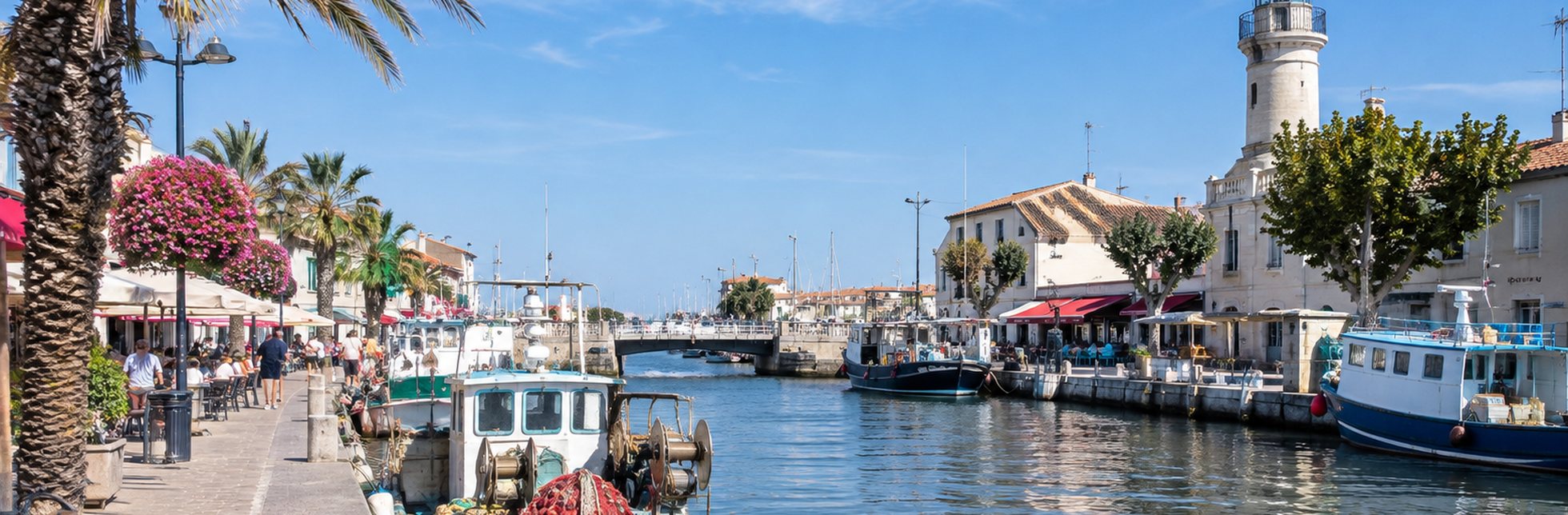
The downtown area of Le Grau-du-Roi stretches along two banks separated by the channel in the Gard department. On the left bank, shops, the market, and outdoor cafes bring the waterfront to life. On the right bank, the old lighthouse and 1930s-era houses set a more peaceful pace. Between them, the swing bridge opens several times a day to let boats pass through.
Our team at Les Jardins de Tivoli, a campsite in Le Grau-du-Roi since 1998, will guide you pier by pier.
Key Takeaways
- The channel divides the city into two banks: the left bank, which is commercial, and the right bank, which is residential.
- The swing bridge, which has been in service since 1951, connects the two main quays.
- The market is held at Place de la République on Tuesdays, Thursdays, and Saturdays, from 8 a.m. to 1 p.m.
- The old lighthouse, at 2 Quai Général-de-Gaulle, dates back to 1828 and is still open to visitors.
- The trawlers return around 5 p.m.: this is when the quays are the most alive.
The swing bridge, the metronome of the two piers
The swing bridge sets the pace of the city. Commissioned in 1951, it pivots over the channel and halts traffic for a few minutes each time it opens. According to the Grau-du-Roi tourist office, three bridge operators take turns operating it from their booth.
The first opening takes place around 3 a.m., when the 16 trawlers head out to sea. For recreational boaters, the bridge opens at 8:00 a.m., 10:15 a.m., 12:30 p.m., 2:00 p.m., and 6:30 p.m. These schedules explain the midday lines, especially in the summer.
This channel isn’t just for show. It connects the sea to the fishing port, then continues on toward Aigues-Mortes and the Camargue region of the Gard. Before the bridge was built, the crossing was made by a toll ferry from 1840 to 1901. Three bridges followed one another, one of which was destroyed in 1944.
Our favorite moment: the return of the trawlers, around 5 p.m. The bridge rotates, traffic comes to a halt, and the boats make their way up the channel, escorted by seagulls. Find a spot on the pier, on the bridge side, 10 minutes beforehand. The scene is brief, but it captures the essence of Le Grau-du-Roi better than any guided tour.
Left Bank: the shops, the market, and the Quai Colbert
The left bank is home to shops, restaurants, and the market. Quai Colbert forms the backbone of Le Grau-du-Roi. The terraces there face the channel, and the pedestrian streets lead to Place de la République. At the end of these streets, the left-bank beach stretches all the way to the Seaquarium.
The market is held there three mornings a week— on Tuesdays, Thursdays, and Saturdays—from 8 a.m. to 1 p.m. On Fridays, a farmers’ and organic market takes over the town hall plaza from 8 a.m. to 1:30 p.m. These are the liveliest mornings of the week. For details on locations and schedules, see our guide to market days in Le Grau-du-Roi.
As for fish, small-scale fishermen sell their morning catch along the canal. They’re there every day except Sunday. Sea bream, octopus, red mullet—everything you need to make a “rouille graulenne,” the local specialty. The restaurants along the quay get their supplies from the same place.
Right Bank: the old lighthouse and the 1930s-era facades
The right bank offers a different experience: fewer shops, more historic sites. The old lighthouse stands at 2 Quai Général-de-Gaulle, at the entrance to the harbor. Built in 1828–1829, it is part of the first program to illuminate the French coastline, launched by Fresnel in 1825. The Ministry of Culture designated it a historic monument by decree on October 9, 2012.
Behind the lighthouse, the tourist office is located in Villa Parry on Rue du Sémaphore. The neighborhood is well worth a stroll, away from the waterfront.
The facades from the 1930s evoke a bygone era. At that time, the village was divided between the “Tonkinois” on this side of the canal and the “Calabrais” on the opposite side. A wealthy resident of Nîmes had the Maison du Dauphin built there in the Art Nouveau style. This historical division still explains the town’s two distinct atmospheres today.
Good to know: The guided tour of the lighthouse house lasts 30 minutes. Tours depart every 10 minutes from 10:30 a.m. to 5:30 p.m., year-round. Be sure to arrive a few minutes early—the group leaves on time. Afterward, head over to the market on the other side of the swing bridge. You’ll have seen both banks in a single morning.
Parking and Driving in Downtown
The neighborhood is best explored on foot, but you’ll want to get there without wasting an hour. Traffic at the Pont Levant roundabout starts to build up as early as 11 a.m. during peak season, peaking around noon. Here are some tips to keep in mind:
- Arrive before 11 a.m. or after 2 p.m. to avoid lines.
- Pay for parking using the PayByPhone app instead of the parking meter.
- Park in a short-term spot, where the first 30 minutes are free.
- Take the electric shuttle—€1 per ride, with 15 stops between Port-Camargue and Le Boucanet.
- Check the bridge opening times before crossing by car.
The zones, rates, and parking packages are detailed in our parking guide for Le Grau-du-Roi.
Biking is still the easiest option in the summer. We rent bikes at the reception desk at the Jardins de Tivoli, and the town has many safe bike paths.
Want to spend the morning strolling along the waterfront and the afternoon at the pool? Book your stay directly at Les Jardins de Tivoli. Our 90 campsites with private restrooms and our Premium mobile homes are booking up fast for the summer.
Sources :
- Grau du Roi Tourist Office, The Fishing Port
- Grau du Roi Tourist Office, The Markets
- Grau-du-Roi Tourist Office, Getting Around Smartly and Stress-Free in Grau-du-Roi
- Ministry of Culture, Mérimée Database, Former Lighthouse of Grau-du-Roi
- Gard Tourism, The Old Lighthouse House in Grau-du-Roi
AI-generated image