


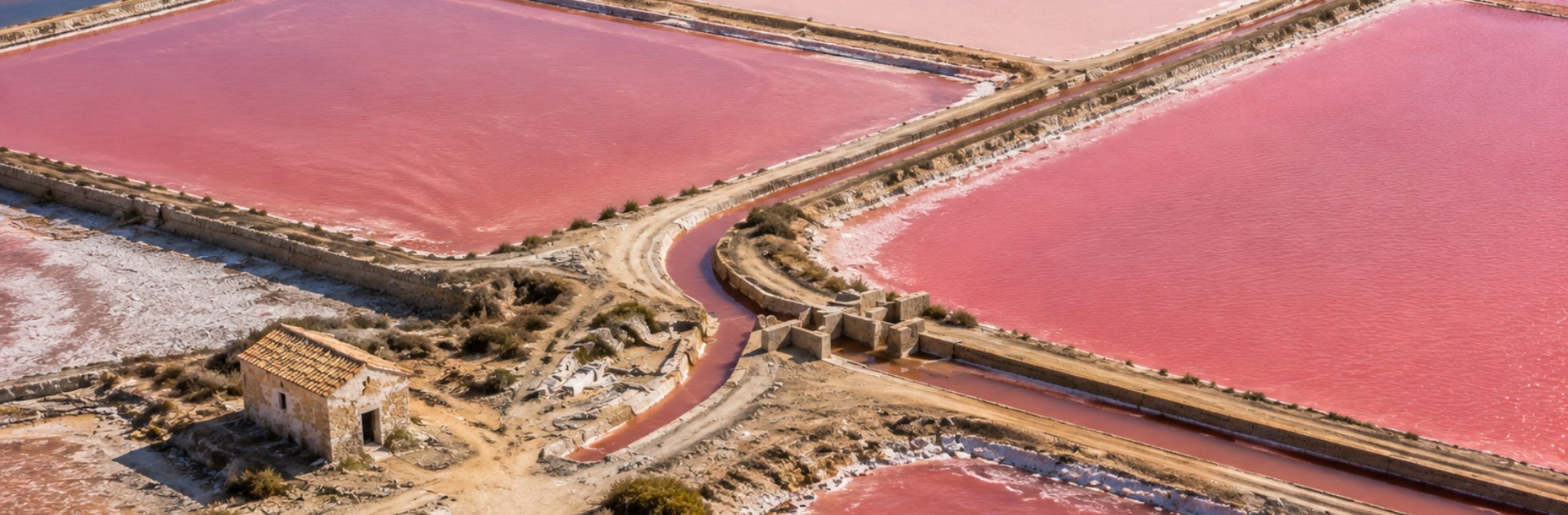
Located between the ramparts of the medieval town and the Mediterranean Sea, the Aigues-Mortes salt flats cover nearly 11,000 hectares of basins where salt has been forming for centuries.
The site combines pink landscapes, salt pans, and the expertise of the salt workers, offering several ways to explore it: a mini-train ride, a guided walking tour, or a bike ride. Here’s what you need to know about its history, salt production, and how to visit, all from our 4-star campsite in the Camargue.
This Topic in 5 Points
- The salt flats of Aigues-Mortes stretch between the ramparts of the medieval town and the Mediterranean Sea, right in the heart of the Camargue.
- Salt production dates back to the Middle Ages and was organized in 1856 under the Compagnie des Salins du Midi.
- The facility produces up to 450,000 metric tons of salt per year across approximately 10,800 hectares of salt pans.
- The water takes on a pink hue due to microorganisms such as the algae Dunaliella salina.
- A mini-train, a guided walking tour, or a self-guided bike tour are great ways to explore the salt pans and discover fleur de sel.
A history of salt dating back to the Middle Ages
The history of the saltworks at Aigues-Mortes dates back well before the Industrial Revolution. As early as the Middle Ages, abbeys were already harvesting salt from this stretch of coastline—a “white gold” that was highly prized at the time for preserving food.
In 1290, the Peccais salt marshes became the property of the King of France, a testament to the site’s economic importance at the time. It wasn’t until 1856 that several neighboring operators merged their salt marshes and founded the Compagnie des Salins du Midi, according to the Camargue Regional Nature Park.
This merger gave rise to one of the largest salt production sites on the Mediterranean coast, which is still in operation today.
How is salt produced at the Aigues-Mortes salt flats?
The salt from the Aigues-Mortes salt flats is formed through the natural evaporation of seawater, which is pumped and then concentrated in a series of basins before crystallizing on the surface. This traditional method involves several steps carried out by the salt workers throughout the summer, leading up to the harvest.
The manufacturing process involves several steps:
- Seawater is pumped from spring through fall.
- It then flows through a series of basins, gradually becoming more concentrated in salt.
- The salt finally crystallizes in the harvesting basins, where it is collected in late summer.
Table salt, harvested from hundreds of hectares
Much of the salt produced at the Aigues-Mortes saltworks is used for human and animal consumption.
According to the Camargue Regional Nature Park, the site has a production capacity of 450,000 metric tons of salt per year across approximately 10,800 hectares of salt pans. Today, about ten salt workers tend to these pans, carrying on traditions passed down from previous generations, according to the Gard Tourist Office.
Fleur de sel, harvested by hand in the summer
Fleur de sel is the thin layer of crystals that forms on the surface of the salt pans; it is harvested exclusively by hand, without the use of any machinery.
According to France Bleu, the harvest takes place between early July and late August, when the salt workers, wearing rubber boots, collect an average of 28 metric tons of fleur de sel each day, for a total of around 1,000 metric tons over the summer.
Luc Vernhes, a retired salt worker with 40 years of experience, continues to lead some of the harvest tours. He sums up his love for the trade this way: “Salt is a wonderful product!”
Visiting the Aigues-Mortes salt flats: by mini-train, bike, or on foot
There are several tour options available to explore the Aigues-Mortes salt flats, depending on how much time you have and what you’d like to do. The little train is ideal for families with young children, while the guided walking tour and self-guided bike tour offer a more active immersion in the heart of the salt pans.
| Format | Duration | Adult Price |
|---|---|---|
| Little Train | About 1 hour and 15 minutes | Starting at €14 |
| Guided Walking Tour | Approximately 1 hour and 45 minutes, covering 4 km | Starting at €22.50 |
| Bike on Your Own | Choose between 12 or 30 km | Starting at €22.30 |
The little train takes visitors to a ” camelle“—a pile of salt towering over the site—for a panoramic view of the ponds and the medieval town.
The guided walking tour, led by a nature guide, combines explanations about the work of the salt workers with opportunities to observe local wildlife.
Finally, the self-guided bike tour—with routes of 12 km or 30 km—is ideal for those who want to explore the site at their own pace, with the longer route leading all the way to the seawater intake.
Good to know: The staff at Les Jardins de Tivoli campsite recommend visiting in the late morning or late afternoon, when the low-angle sunlight best brings out the pink hues of the pools. A hat, water, and sturdy shoes are essential in the summer, as there is little shade among the salt pans.
Practical information
Here is some useful information for planning a visit to the salt flats of Aigues-Mortes:
- Address: Route du Grau-du-Roi (D979), 30220 Aigues-Mortes.
- Hours: The site is open from February through mid-November, then for a few weeks at the end of the year; departure times are extended in the summer, with slots available into the evening.
- Prices: Starting at €14 for an adult on the mini-train (€10 for a child), and starting at €22.50 for an adult on a guided walking tour (€15 for a child).
- Contact information: Phone: 04 66 73 40 24; email: salinstourisme@salins.com.
- Amenities: gift shop, picnic area, parking, and a pop-up restaurant on site.
A little extra: After the tour, head to the on-site shop to pick up a bag of fleur de sel or a jar of flavored salt—a thoughtful touch that will help you cherish the memories of your day in the Camargue.
Are you planning a trip to enjoy both the beaches and the Camargue countryside? Round out your visit to the Aigues-Mortes salt marshes with some relaxation by the water: book your campsite or mobile home at our Campsite near Aigues-Mortes, in Le Grau-du-Roi, just a stone’s throw from the Mediterranean and the Camargue.
FAQ – Aigues-Mortes Salt Flats
How long does the tour of the Aigues-Mortes salt flats take?
The duration depends on the format you choose. The mini-train tour takes about 1 hour and 15 minutes; the guided walking tour lasts nearly 1 hour and 45 minutes and covers about 4 km; and the self-guided bike tour covers 12 or 30 km, depending on the route you choose.
Can you visit the salt flats in Aigues-Mortes year-round?
Yes, the resort remains open for most of the year, from February through mid-November, and then for a few weeks at the end of the year. However, operating hours and the number of departures are reduced outside the summer season.
When is the best time to see the pink ponds?
The pink color of the salt pans, caused by microorganisms such as the algae Dunaliella salina, is most pronounced in the summer, when salt concentrations peak. This is also the season for harvesting fleur de sel, between July and August.
Do I need to book in advance?
Yes, booking is recommended for all tour options and required for the guided walking tour, with a deposit payable by credit card. The mini-train also requires a minimum number of participants to operate.
Are the salt flats at Aigues-Mortes accessible to children?
Yes, the Aigues-Mortes salt flats are accessible to children. The little train welcomes families with children ages 5 and up, while the guided walking tour and self-guided bike tour are booked for children ages 8 and up, due to the distance covered.
Where can I buy fleur de sel from the Aigues-Mortes salt flats?
There is a shop on the premises, located at the small train’s arrival point as well as at the end of the other tours. Visitors can find table salt, fleur de sel, and related products there to take home as souvenirs.
Sources :
- Gard Tourist Office, Salins d’Aigues-Mortes
- Camargue Regional Nature Park, Salt Production in the Camargue
- France Bleu (HERE), The fleur de sel harvest is in full swing in Aigues-Mortes
- Official Website for Visiting the Camargue Saltworks
AI-generated image